AI Video for Deskless Workers: The Solution to the 80% Problem
Jul 02, 2026
3 months ago
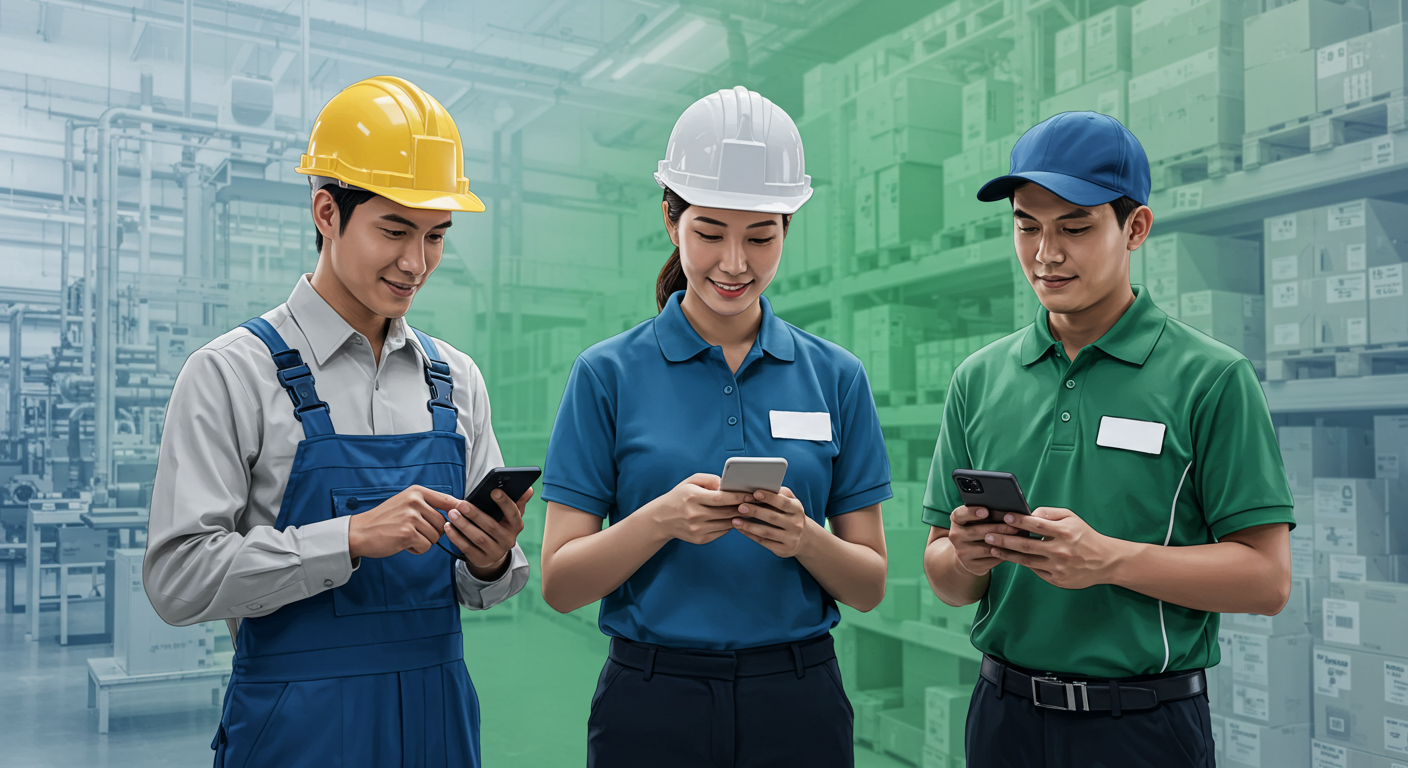
I was in a conversation with a COO of a major logistics company recently, and he said something that stuck with me. “We spend millions on state-of-the-art training for our office staff,” he told me, “but for the 80% of our people who actually move the goods, we’re still using paper manuals and hoping for the best.” It’s a huge disconnect. This is the reality for the 2.7 billion people who make up the global deskless workforce. We’ve built our corporate training infrastructure for the minority who sit at a computer, completely ignoring the people on the factory floor, in the retail store, or out on the road. The solution requires a fundamental shift in our thinking, and it starts with AI video for deskless workers.
Who are the people we’re leaving behind?
When we say “deskless workers,” we’re not talking about a niche group. We are talking about the majority of the global workforce. They are the nurses in our hospitals, the technicians maintaining our infrastructure, the retail associates who are the face of our brands, and the logistics teams who keep our supply chains moving. Their workday doesn’t happen in front of a screen. They are in constant motion, solving real-world problems in real-time. Giving them a login to a traditional, desktop-first learning management system is like giving a driver a textbook and telling them to read it while on the motorway. It just doesn’t work.
The real cost of a disconnected training strategy
The consequences of this disconnect are not trivial. For a manufacturing company, it can mean a critical safety procedure is missed, leading to accidents. In retail, it results in inconsistent customer service and brand representation across different stores. One of the biggest challenges in these sectors is high employee turnover. When new hires are not given the tools to succeed from day one, they are more likely to leave. The cost of recruiting, hiring, and training their replacement is immense. We can’t keep applying the old training models and expect a different result. It’s expensive, it’s ineffective, and it’s frustrating for the very people we need to empower.
The only way forward: mobile-first microlearning
If you want to train someone who doesn’t have a desk, you have to go where they are. That means training has to be delivered on the one device they all have: their mobile phone. This is more than just making your old eLearning modules responsive. It requires a complete change in approach. It requires microlearning. Think short, 1-to-3-minute, highly focused pieces of content that a worker can access in the flow of their work. A driver can watch a quick video on a new delivery protocol while waiting to load their truck. A retail worker can see a 90-second product demonstration before a customer walks in. This approach respects their time and gives them the exact information they need, right when they need it.
How AI video for deskless workers bridges the gap
This is where I see the most significant opportunity. Creating high-quality video content, especially in multiple languages, has historically been a slow and expensive process. That’s why it was reserved for big corporate initiatives. But AI video generators change the economics and the speed of creation.
With a platform like Immersive Fox, a training manager can take a simple text script and turn it into a video in minutes. This solves the core challenges of training the deskless workforce:
- Scale: You can create a single, perfect training message and distribute it to thousands of employees instantly. No more “train the trainer” sessions where the message gets diluted at each step.
- Language: This is a critical one. Deskless workforces are often incredibly diverse. With AI, you can take a safety video and, with a few clicks, have it available in 50+ languages, with a culturally relevant avatar and a natural-sounding voice. This is a game-changer for inclusion and comprehension. Check out our post on the real cost of multilingual video production to see how this works.
- Consistency: You can ensure every single employee receives the same, high-quality training, whether they are in a flagship store or a remote warehouse. This is vital for everything from brand standards to safety compliance.
- Speed: A new compliance rule or an urgent product recall can be turned into a clear, concise video and sent out to everyone in less than an hour. The days of waiting weeks for a production crew are over. As an external source from Mobietrain points out, this mobile-first approach is the only way to reach this workforce effectively.
Imagine the impact in manufacturing
Think about a common scenario on a factory floor. A new piece of equipment is installed. The official manual is a 200-page PDF, impossible for anyone to digest. The old way involved a rushed, inconsistent training session. The new way? The plant manager identifies the 10 most critical safety and operational procedures in the manual. They use an AI platform to turn those procedures into a series of 2-minute videos. QR codes are placed on the machine itself. Any operator, at any time, can scan the code and get a quick refresher on how to perform a task safely. The videos are available in every language spoken on the floor. The result is a safer, more efficient, and more confident workforce.
Or consider the challenge in retail
Retail is a fast-paced environment with high turnover. Onboarding needs to be quick and effective. Instead of putting a new hire in a back room for a day to read binders, what if they could learn on the floor? With AI video, you can create a library of micro-lessons. “How to set up a promotional display,” “Our 5 steps for greeting a customer,” “How to process an online return in-store.” New employees can access these on their phones, learning as they go. It makes training a continuous part of the job, not a one-time event.
For too long, we have treated our largest and most vital group of workers as an afterthought in our training strategies. The technology to finally bridge this gap is here. It’s not about replacing human connection. It’s about using AI to scale our best knowledge, to deliver it in a way that respects the reality of deskless work, and to finally give 80% of our workforce the tools they deserve.
Have project in mind?
Get in touch with our sales team